A Meditation on Trees
An Essay

1
In the spring, the Manitoba maples along my front street form a skeletal arch over the road. As the days lengthen, the new green of leaves begins to hide the empty branches of winter; and soon, a pale mist of leaves covers the trees, which will become a mass of foliage in the summer, arching over the road.
I am eight years old. I stand on the road and look down the street that has now become a shadowy tunnel of leaves. WE play here as the evenings lengthen.
Trees form important meeting places for us around the neighbourhood. Down the block are four giant willows that border the house of Mr. and Mrs. McFee. Mr. McFee doesn’t mind if we climb them. We gather at the trees to make plans, to talk, and sometimes just to play. One of the trees lost a limb, the stump black with tar where Mr. McFee painted it.
In the fall, I am on the sidewalk and looking again down the length of the block. The trees are turning gold, the ground spotted in fallen leaves, fast turning brown. When I turn and look to the next block to the south, the trees there are already fully golden. It’s as though the trees know to only turn one block at a time.
In the backyard, the evergreens seem to darken as the maple yellows and loses its leaves. And for a brief time, I can stand between the lilacs that grow beside the fence, the branches arching overhead to form a golden canopy.
2
Family trips took us to many places. We traveled into the north where forests grew thick, pines and poplars and spruces and aspens growing in a tangle, until you came out of the trees onto a clear corridor where cattle grazed and walked and shat.
We drove to my cousins’ farm in southern Alberta, where trees didn’t grow. I had to get used to the wide spaces, only here and there interrupted by bluffs of trees.
I walk across these wide fields with my cousin. The wind here blows straight as a ruler. And I can see all the way to the horizon, where the misty shapes of mountains line the edge of the world. Not until we visit the river did I see trees in the way I knew them at home, clustered thickly above the banks.
3
Each time I move, I meet new trees. If, for a while, I’m somewhere trees are not close, then I’m cut off from something that forms part of my boyhood.
I lived for a while in an apartment that overlooked a busy avenue. No trees near by—just light standards, yield signs, stop signs, bus signs, and telephone poles. They are tree-like in their verticality, but they are markers on an urban landscape, populated by people walking, people in cars, people in buses.
I lost my sight when I was ten, and now I am eighteen and newly moved away from the family home. I am cut off in this apartment—the window facing onto a busy avenue and my life beginning to unravel.
4
My wife and I lived in a house for two years when we were first married. In the front yard were two giant poplars. The landlady lived next door. She decided it was better to cut off all their branches, leaving two twenty-foot stumps that leafed out in the spring. They looked for all the world like two inverted exclamation points.
We moved from there to a small town, surrounded by the flatness of prairie. Our first daughter is born.
Trees are more deliberate here. They grow in the yards of homes, near the playground, or up and down the street. When I walk, I take the road out of town, and I am surrounded by emptiness—field upon field of crop and pasture, with nothing to stop the wind for a hundred kilometres. I remember that cutting wind from my boyhood.
5
In my thirties, I live with my two daughters in university housing. A giant May tree stands outside our unit. It blooms in spring, dropping its petals early to form a covering on the ground like dried snow that rustles under foot.
One year, we had a spring snowstorm. Heavy, wet snow fell for a day and a half, weighting and bending the trees in the park so they broke and snapped. The work of cutting and clearing broken limbs and dead trees went on the rest of the that spring, the branches piled into a long stack at the far end of the road near our house.
6
My kids and I move into our new house at the end of June. The yard is overgrown with trees—a birch in the front, and next to it a tall spruce and Mugo pine. In the backyard, a crab apple tree stands in front of the garage, a pine beside the house, and another spruce and two more pine at the back of the yard that was a tangle of shrubs and smaller trees.
7
I didn’t know much about trees, but my cousin’s husband did. I let him take charge. The first to go was the Mugo pine in the front. It was more a shrub that a tree. Then he cleared the back of the yard. It was as dense as a forest, but it needed to be cleared. Three large trees still stand back there.
But I needed to do more. I hated the thought of cutting down trees. But I also began to hate the crab apple tree. The thing was full of small apples, no good for anything. And they fell in the summer, fell before they were even ripe. And they became rotting patches of slime on the ground, where I sometimes stepped in bare feet. I gathered and gathered them, sometimes scraping them up with my hands, throwing them away by the box full; until, one day, I couldn’t stand it anymore and had the tree cut down.
Suddenly my backyard seemed full of sunlight. It could reach the house, filling the kitchen and my study with light, which was most welcome, especially in the spring and fall.
8
It was the birch that got me. The thing was slowly dying. When we moved in, it had three giant trunks, reaching up and up and shadowing the yard. Then we had drought, year after year, and first one, then another of those great trunks died, until just one remained, growing thinner each year.
I had a guy who came and helped in the yard. He was a make-work guy. He kept telling me about things he needed to do in the yard, mostly so I would keep paying him.
He cut down the tree one afternoon. We had been talking about the tree and what to do. Then one day, I came home to find the tree in piles on my lawn. I felt bereft and angry. But I thought, I could be mad, or I could do something.
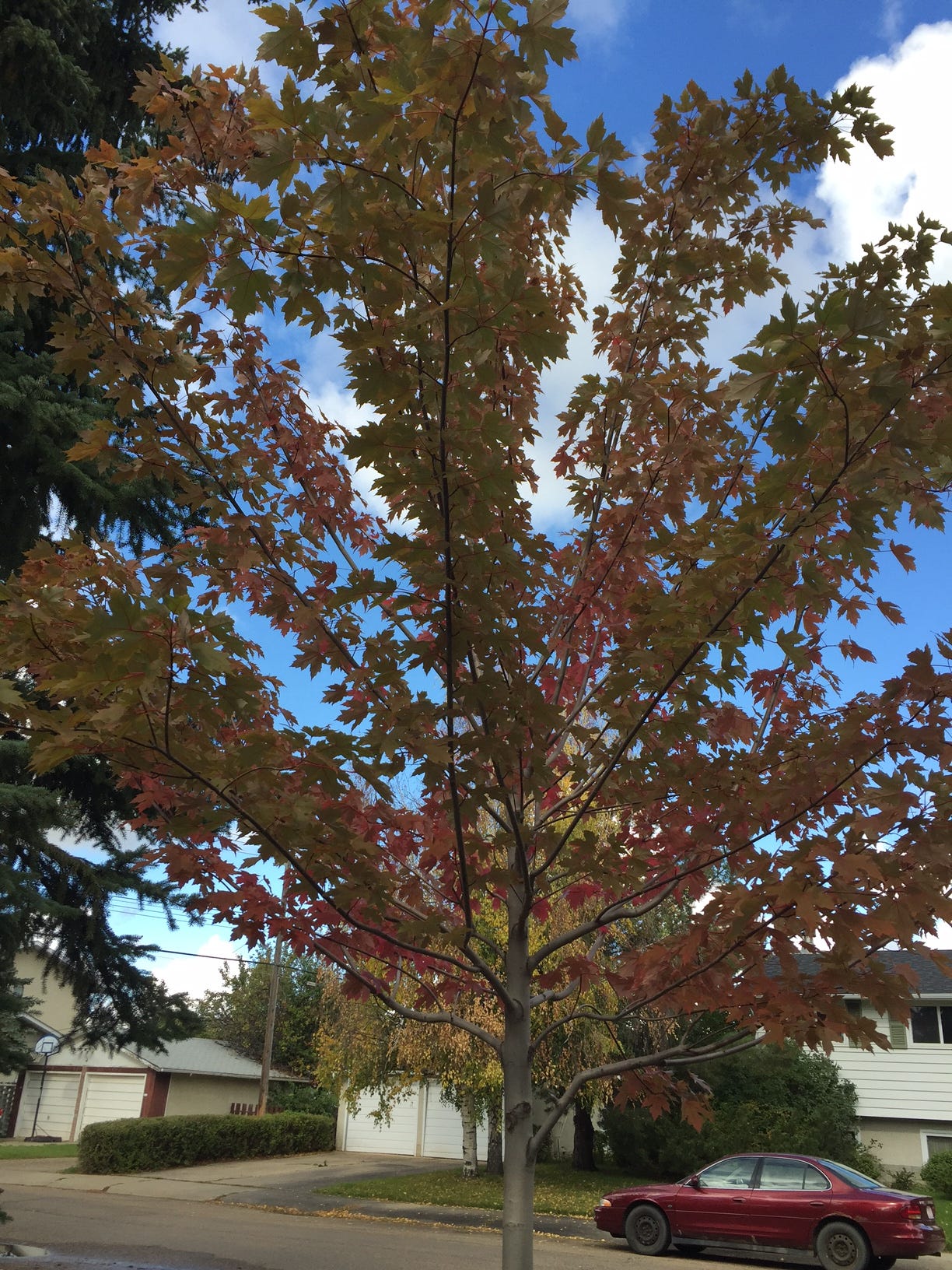
I called my cousins once again, and we began searching for a tree. I called a stump grinder to come and deal with the stump of the birch. For a while, I had a great hole in my front yard. Then we found a tree. My cousin found it—she has an eye for that sort of thing. She found a slender, beautiful young maple—a true maple, not like the maples that grew up and down my front street as a kid.
And then it was delivered. A truck backed onto my lawn and dropped the maple into the waiting hole. We mounded the earth over the root-ball, then my cousin and his son pounded in two metal stakes to support the tree, and there it stood, new and beautiful.
I cared for that tree like it was one of my kids. I watered it and looked after it. Two years later I pulled out the stakes, and it stood on its own, tall and slender and straight. And now in the summer it casts a shadow over the lawn while it rustles in the breeze; and in the fall it stands tall and turns red as red, like a living beacon on the street.