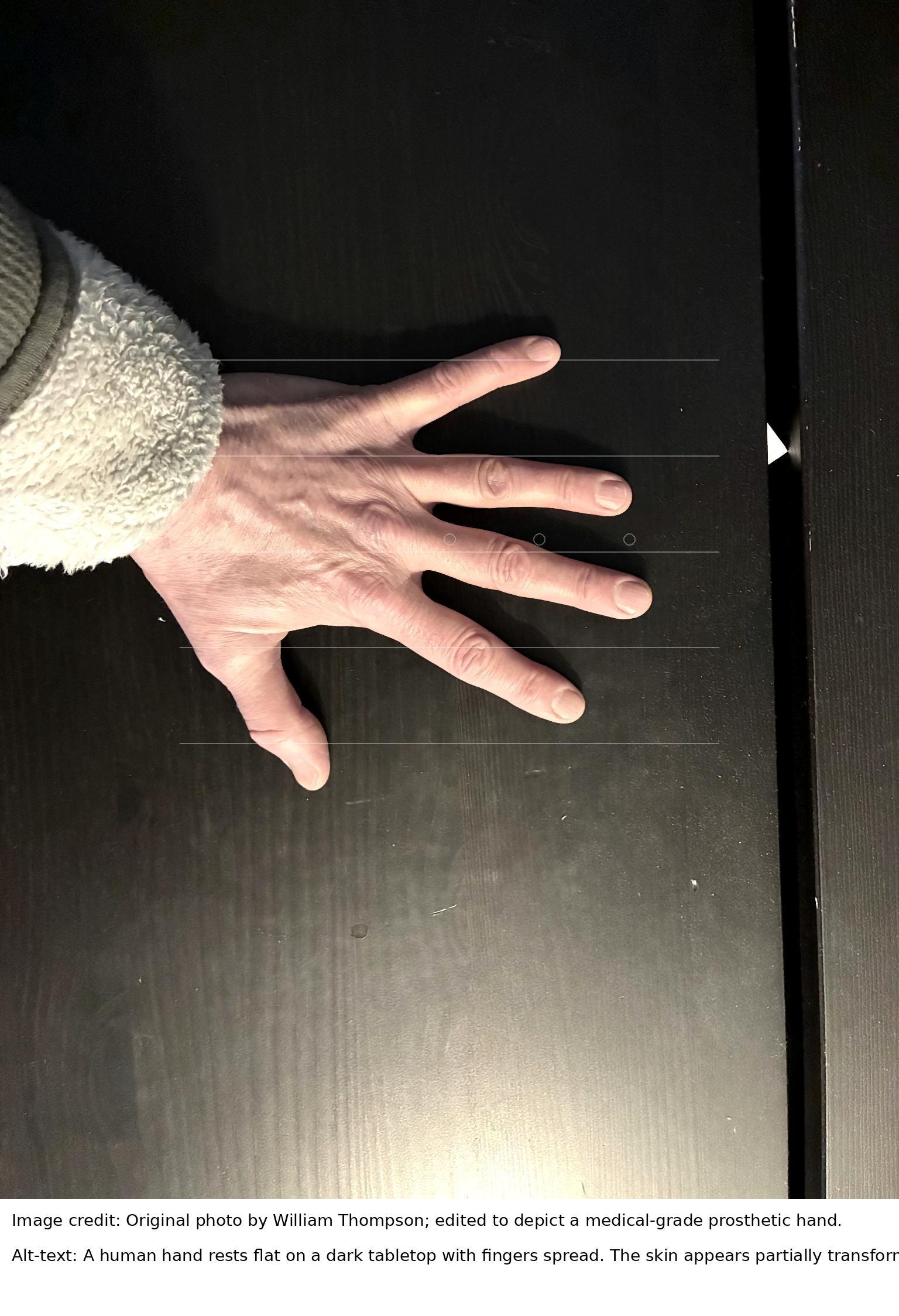
Extremities
A Science Fiction Story

David still sometimes reached for things with his right hand. He was always oddly surprised to see it wasn’t there. It had only been fourteen days—fourteen days and counting. But after taking his meds he could momentarily forget the loss of his hand. Then he would look, and there it was—or wasn’t.
David had been ready for the pain. The doctor told him he would have pain—that deep, throbbing ache in the stump of his wrist. That’s what the meds were for. The doctor also told him to expect phantom pain. Pain in a hand that wasn’t there—the ghost of a hand that remembered being crushed in a press at work.
He also hadn’t been ready for the boredom. He read, sometimes, flipping through books or news articles on his tablet. He sometimes watched the news feed, but that became just depressing. He spent more and more time at his window, watching the traffic, the people, and the bots endlessly to-ing and fro-ing in the street four floors below. He went out several times, but it was too loud, too busy, and too close, and he could feel his skin prickling in response.
He hadn’t been ready for the dreams either. They were fragmented, indescribable and yet vivid—all together nightmarish. He generally woke feeling exhausted.
On day fifteen, David gasped himself awake. His hand hurt. He called for the lights, and the cheap lamp beside the narrow bed flicked on to glaringly show the sparsely furnished room. He looked blearily down at the stump of his arm—his not-hand, aching with remembered pain. He could feel his hand flexing—the muscles in his forearm tensing and releasing, but there was no hand.
He breathed, slowly and carefully, trying to get on top of the pain—the pain from a hand that wasn’t there. Shoving back the covers, David sat up on the edge of the bed. He felt his feet find contact with the cold floor—he focused on the floor, hoping to draw attention away from his aching not-hand. That’s what he had begun to call it—his not-hand. The hand that wasn’t there anymore, the hand he had lost in an accident at work.
“Fucking bots,” he said, aloud to himself.
The plant where David worked—had worked now for going on seven years—was automated. Bots did most of the work, but they made mistakes—David was one of those who made sure the bots didn’t mess things up.
The bot was just doing its job—it was compressing a three-by-four-metre plastiform sheet. Compression was the last stage in creating the sheets before they were set to dry. David did a quick check as the bot prepared to compress the sheet—and there, a half-metre from the edge of the sheet was a glove, an honest-to-god work glove.
How the Christ did a glove get there?
David swore aloud and grabbed for it. If the bot had compressed the sheet with that glove between the plates, it would have ruined the sheet.
He knew it was stupid, even as he reached between the plates. The bot was programmed to check whether foreign objects had somehow adhered to the sheet before pressing it, even dust. It was supposed to align the sheet, check the surface, then evenly compress it. But something went wrong. His hand was caught, and there was nothing he could do.
***
David let the floor take his weight. His feet could feel the slight unevenness in the laminate. His whole body felt like that—over sensitive and aware, as if every pore had become a receptor for the world around him.
He shuffled into the tiny bathroom, trying hard to manage his body’s response to the world. Things began to settle once he was in the kitchen and preparing coffee. Regular tasks were now difficult—he had to think about every detail. He made the coffee one-handed. Making the coffee, once a ritual had become a chore, a barrier, something to overcome. But having to figure out a way to make the coffee was better than no coffee at all.
Everything had become like that—every goddamned thing from using the bathroom to dressing to working his tablet. He had taken to always sitting on the toilet, just to make it easier. He had to manage everything with his left hand—it was like trying to do things with a different part of his brain. He had to think about the simplest act. It was exhausting.
As the coffee bubbled, he checked his schedule. His PD told him to be at the clinic at 3:00.
David was off work for another ten weeks. The company had given him twelve. Twelve weeks for a hand. David awkwardly poured coffee left-handed. He wondered if you got more for other parts. How many weeks if you lost a foot or a leg?
He gave himself an extra hour to get out of the house. Showering was manageable, but shaving was impossible. He had decided to grow a beard. He carefully filled the kettle. He dropped a protein cube into a mug, slowly pouring in the steaming water. He was conscious now of things that could hurt him—he could drop the kettle and scald himself, he could spill his protein porridge. There were a thousand small accidents that could happen throughout the day, happen in a second, irrevocably changing his life. He slowly stirred the porridge, then sipped carefully.
David wore a sling after the first time he went out. People seemed to understand an injured arm better than they did a missing hand. That first time out, a man had visibly recoiled at the sight of David’s stump. David decided after that a sling would be better.
***
David waited for the train. He watched it pull into the platform, and was suddenly aware that it too was a bot. A great long bot that wormed its way through the city on a track, picking people up and dropping them off. He had never thought about how many bots worked in and around the city before losing his hand, and now he saw them everywhere. Many never seemed to work properly, either—a cleaning bot stuck in a corner as he walked through the pedway to the train, or the sweeper bot stuck in the middle of the street. It all created a low-level anxiety that settled itself in his lower abdomen, like the hum of a power converter.
He sat in the waiting room of the clinic. He had to fill out forms. It was awkward holding his tablet, and at one point, he had to approach the woman at the desk to ask for help.
She was shaven-headed, twenty-something, and disengaged. She barely registered his missing hand—he was sure she had seen much worse. She helped him willingly enough, but he could see something retreating in her eyes. At first David thought it was a way to deal with all of the disfigurement at the clinic, but he realized he saw that look all the time. It was the look of people who had switched off the world in some fundamental way—shut it off to avoid what the world offered, or what the world insisted everyone see.
David saw the same look in the mirror each morning—or at least he had. It was the look he got when preparing to leave the house. Preparing to go out into the world and meet with the same disengagement in the faces of others. But you didn’t have to fully engage the world, not really, especially when the bots kept everything running, or most of it. Maybe it was the vague understanding that people weren’t that necessary anymore. The bots took care of things; they did all the small, dirty, and irritating jobs people didn’t want to do. This was the world the bot companies had promised—a world where people didn’t have to work as hard, where they didn’t have to suffer as much. But it came with a price, and not one anyone expected. Perhaps people didn’t have to work as hard, and perhaps people didn’t suffer as much—that’s what the newsfeed said every day. But a kind of apathy had crept in, a disengagement that separated people from one another. Part of that disconnection was a mistrust of the technology that kept the world running, and part of it was the uncomfortable awareness that the bots had relieved humanity of something important, but what that was, David couldn’t say. He just knew he was somehow more engaged now. Funny, he thought, considering there was now slightly less of him.
***
David had to wait more than ninety minutes before he saw the doctor. The twenty-something showed him into a small office, set with two chairs, an examination table, and a desk. The doctor came in after ten minutes. She looked at David directly and clearly—that surprised him, but maybe he just wasn’t used to it.
She did a general exam, then a closer examination of his stump. She asked about pain in the stump of his arm, about pain generally, about his vision—headaches, appetite, sleeping. The questions went on and on.
Finally, she stepped back to type into her tablet. “Well,” she said, “I would say you’ll be ready for a new hand by the end of the month.”
David was slow to respond. “A new hand,” he said.
“Yes, a robotic hand. It will have all the functionality of your old hand and more. You will have to learn how to use it, of course,” she added, “but that’s what the therapy is for.”
“Therapy?”
“We call it therapy, but it’s really rehabilitation. I’ve sent a request to the centre for a fitting date. They will be in touch with you about an appointment.”
She paused. “One last thing. You’re going to have to drop the pain meds seventy-two hours before the fitting.”
“Drop the pain meds?” Even in making the statement, David knew he had come to rely on those meds.
“I’m afraid so. In order for them to make a proper fitting, your system needs to be clear of narcotics. ... Any questions?”
He had questions, but he didn’t know how to ask. And the doctor was clearly done with him and ready to move to her next patient.
***
The rehab centre was part of the same complex where David had seen the doctor ten days before. He had dropped the pain meds, but he had relied on a measure of whisky each night to help him sleep. He couldn’t afford real whisky—this was the synthetic swill you could get at any corner store. But it did the trick; it kept him asleep until the metallic dawn lightened the window of his tiny bedroom.
David hadn’t known what to expect in getting fitted for a new hand. As he sat back, his arm strapped to a right-angle extension, he could feel his brain checking out, just as it had for so much of his life. But this time, it was in a kind of self-defence. He didn’t want to fully experience receiving this bot hand. He watched, as from a distance, as they ran tests on the stump of his arm. A blurry interlude. Then it was attached.
He stared at it—this thing, attached to the end of his arm. Silvery grey in colour, lacking fingernails. It looked like a metallic glove stuck on the end of his arm.
“Don’t worry,” said the technician, a smooth-faced figure, slender and fine-boned in a slightly overlarge lab coat. They grinned. “We add the skin and fingernails later. For now, you can wear a glove, and no one will know the difference.”
At first, David didn’t like to look at it—his bot hand. His brain had retreated from what was happening to him. They gave him exercises he had to do six times a day. His bot hand was like something foreign that had attached itself to him—something strange, something alien. He watched the metallic thing feebly flex and grasp the hollow ball made of hard rubber.
But day followed day, and the new hand, the bot hand, could do more and more. Soon, it could pick up a glass. It could hold a spoon and stir his morning porridge. David could make it do things, like teaching a pet bot to do tricks, but the hand felt separate from him, like one of the bots at the plant, but this one was attached to him.
One morning, David picked up a glass from the counter. He suddenly stopped, holding the glass, and staring at it. Slowly, the nerves in his arm began sending a message to the bot hand. The fingers flexed. The glass shattered.
***
The morning he broke a glass was the day David seemed to cross a line. He didn’t understand it, not at first.
He was sitting later that day in the rehab centre at a long table. Several other people were in the room, performing tasks of various kinds. David was using his new hand to sort a selection of nuts and screws—some larger, some smaller. David was sorting them by size. It was, as the rehab tech told him, to improve his fine motor control.
His new hand had sensors designed to work with the nerve endings in his arm, but he was having trouble using them. He had been doing such tasks every other day now for two weeks, and he had been practicing at home. But until now, when he tried using the sensors in his hand, it was like feeling objects through a thick cotton pad. Most of the time it didn’t work very well.
David diligently sorted, separating first the screws by length, then thickness. He had four piles. Then he turned to the nuts, again sorting first by size.
“You’re doing well.”
David looked up startled. A tall, heavyset man in a lab coat stood beside him, watching closely.
“Thank you,” said David.
“Pick up that one,” murmured the man, pointing to a flat fleck of metal on the table.
David wondered who he was—a doctor, probably. David assumed he was someone important in the clinic. He had a different authority from that of the technicians. No one else seemed to notice.
David obliged, reaching for the flat bit of metal, hardly bigger than a snowflake. He tried to pick it up, but his hand felt suddenly clumsy again. It was like wielding a club at the end of his wrist.
“Close your eyes,” said the doctor, leaning over him.
David closed his eyes.
“Now feel down your arm and into the hand.”
The voice above his right shoulder was quiet.
David reached his awareness down his arm. There was his arm. And there was his not-hand, the shadow hand—the hand that was gone, but still there, the phantom hand, as one of the doctors called it.
But slowly, David felt something else. Another hand, like a photograph placed over his not-hand. It was as if they were trying to connect, trying to come together. And as they began to merge, David could feel a prickling beginning to run up his arm. There was a new awareness in his touch, an awareness of the table, the plastiform table-top that was the same material the bots made in the plant where David worked. He was aware of the compressed molecules under his fingers, the flaws in the surface where the compression wasn’t quite even. And there it was—the tiny metal ring, no larger than a snowflake, but now a shape he could feel, including the tiny warp along one side that would be invisible to the eye.
“I can feel it, but I don’t think I can pick it up,” murmured David. He opened his eyes.
The doctor was smiling down at him. “Very good,” he said. “One more thing.”
He picked up a large screw from one of the piles and held it out. “Bend this,” he said.
David took the screw. It was six-centimetres long—a bolt rather than a screw, he thought. David held it for a moment, feeling into the metal. He could feel the stress lines running through the threads, points where it had taken some great strain. David caught the bolt with his first and third fingers. His thumb found one of the stress points, and slowly, clumsily, David bent it in half.
The doctor smiled. “Very impressive. You’re doing well.” He patted David on the shoulder and moved on.
David was sweeping the nuts and screws into a plastic box when a woman stopped by the table. She was dressed in a silvery-grey suit and vibrantly blue top. David had seen her around the centre. She had never spoken to him, never noticed him at all. She reached out and picked up one of the screws from the box. She held it out to David, then snapped it in half.
She looked at him. “You aren’t the only one who can do tricks like that. Although I wouldn’t do that at parties.”
She dropped the fragments into the box and walked away.
***
He saw the woman the next week as he was leaving the rehab centre. She was at the long counter, speaking to the bored-looking twenty-something. David fell into step beside her as she walked towards the exit.
“Not interested,” she said, not even looking at him.
David stopped, letting her go ahead and through the doors.
It wasn’t until the next week that she talked to him again. David’s rehab was moving quickly. He could use his new hand for almost everything. He still wore the glove, but soon they would give his hand the appearance of a real hand.
Funny, thought David. This was his hand, now. He no longer thought of it as the bot-hand.
He was sitting in a chair waiting to speak to Thell—she was the twenty-something. He’d finally asked her name. She had looked at him, almost giving him her full attention.
“It’s Thelma,” she had said. “Call me Thell.”
David took this as an acknowledgement—or at least that he’d not made a pain in the ass of himself.
He was waiting for Thell to be free when the woman sat two chairs over. She was wearing the same silvery-grey suit and this time a shockingly pink top. David shifted slightly, automatically assuming the barrier that people used to block off personal space in the crowded city.
“You won’t lose it, you know.”
David looked up, startled, then down at his hands. He was cradling his new hand in his left. He looked back at the woman. “Not interested,” he said.
Just then Thell waved him up to the desk.
***
They sat at a small table. Grace sipped her coffee and watched him. David wasn’t used to anyone’s gaze, not like that.
She had been in the waiting room as David came out from therapy. He was heading for the main desk—he had finally nerved himself up to ask Thell to dinner. And there was Grace, standing to one side of the long counter. Grace caught his eye.
Thel was on her pad, speaking quietly into her headset. He would have to ask her another time. A little reluctantly, David walked towards Grace.
Grace introduced herself, then asked if he had time for a coffee. He had agreed, and they walked together into the darkening afternoon.
And here they sat, in a crowded coffee shop a block from the clinic. David carefully sipped his coffee, still using his left hand as he didn’t want to draw attention to his new hand, still encased in a black glove.
“It was a fire,” said Grace, now, looking at him levelly.
David inhaled—he hadn’t even asked the question.
“You must be curious,” she said.
“Well, yes,” said David, setting down his cup. He sat back slightly, glancing around the coffee shop. All these people, all these conversations, all these concerns. David felt claustrophobic.
“I lost my right arm and leg in a fire,” said Grace. “I had burns to 85% of my body. They couldn’t do anything about my arm and leg, so they replaced those. As for the rest, they grew synthetic skin and grafted it on—lucky for me, it took.”
“Took?” asked David.
“Sometimes synthetic skin won’t take—it dies and sloughs off. But mine took. It literally becomes a second skin—except it’s tougher than human skin. It doesn’t tear and it doesn’t wear.
“But of course I don’t tell many people that. People are afraid of us, you know. They hate anyone who is modified. I’m sure you’ve heard that expression?”
David had. In many of the short conversations he had at the centre, he heard the term mods, or modified. It meant anyone whose body had been augmented with technology.
David had first heard the term from Darcy, the technician who regularly checked his hand. “Mod?” he asked. “What do you mean, Mod?”
Darcy looked at him. “It’s a word people have for anyone whose body has been modified with technology.”
David thought about that. “And what about you?”
They smiled. They reached up to place a forefinger and thumb beneath their eyes. “I lost my sight in an accident,” they said, “so I got these.”
“Bot eyes,” said David, looking down at his hand.
“Yes, I could see you digesting your lunch, if I chose to look carefully.”
David’s surprised laugh came out as a snort.
“Exactly,” said Darcy. “I can see your body temperature change without trying, so I always know when people are lying.”
“That’s handy,” said David, drily.
“Don’t worry,” said Darcy. “You’ll find your new hand gives you all kinds of advantages other people won’t like.”
David hadn’t needed Darcy’s warning to avoid talking about his new hand with other people. He wondered sometimes what it would be like going back to work.
“You don’t want people to know you’re a Mod,” said Grace, now. “People don’t like Mods, just like they don’t like bots. But they dislike mods even more.
“I’m sure you remember. Quantum came out with a humanoid series of bots a decade ago, but people hated them. I think they reminded people too much of their own weaknesses.”
“But they have some of those bots at the centre,” David said.
“It’s different there. Two-thirds of the people in the building are Mods. They don’t care about humanoid bots. Don’t you feel differently now that you have your hand?”
David thought for a moment. “I do, but it’s confusing.”
Grace waited.
“I don’t think of myself differently, but I know other people do. After I lost my hand, I didn’t want people to see that I’d lost a hand. It made them uncomfortable. But having a synthetic hand makes people even more uncomfortable. But it’s my hand. At least, now it is.”
Grace watched him with something like pity. “I was stupid enough to tell my friends what happened to me,” she said. “They were sympathetic while I was recovering—came to see me at the hospital and everything.
“Then my skin began to grow. I got a new arm and new leg. I began to walk, to look more like I had before the fire. That’s when people stopped trusting me. They looked at me as if I were a freak. Mutilated, I was an object of pity, but with a new arm and leg, I was something not to be trusted.
“And the new skin meant I didn’t get cold—I just didn’t feel it in the same way. That brought me some unwanted attention. A guy—a creep—saw me leaving the clinic in the evenings. He approached me after I left one evening. Told me he could keep me warm. He walked beside me until he grabbed me and forced me into a doorway.
I was afraid. I couldn’t even scream. So I hit him—it was more reflex than anything. But I hit with my synthetic arm. I shattered his jaw.”
David hardly knew what to say. But Grace seemed to feel she’d said enough. She stood.
“Once you’re finished at the clinic,” she said, “Do yourself a favour. Get a new job. Move apartments, and find new friends, although you might find that one more difficult.”
She left the café, leaving David wondering and looking after her.
***
A month later, David was walking with Thell. He had finally asked her out, and after a long, considered look, she said yes.
This was their second date. They were walking to the cinema, where they would have dinner and watch ... something. David couldn’t remember the name of the film; he let Thell choose.
He had received a cosmetic treatment for his new hand the week before.
“It looks so ... normal,” he had said to Darcy.
“Sure,” they said, grinning, “But you’ll never have to cut your fingernails again. Think of that.”
David walked beside Thell, feeling pleasure in her closeness. He was careful not to touch her, but they walked much closer than the half an arm’s-length distance people usually maintained in the city.
David had taken Grace’s advice—he had moved apartments and was now looking for a job. He felt liberated.
Thell’s face still wore that slightly disengaged expression he remembered from the first day she had helped him at the clinic. She had grown out her hair in the last month—it was short but thick and black, and she had an even, caramel complexion that reminded him of the richness of molasses. Her features were fine, despite the expression that kept the world at bay. Thell was one of the few people at the centre who wasn’t a mod, but this aloof, twenty-something didn’t care if someone was a mod or not.
They paused at an intersection. “Look,” said David, pointing with his new hand. David took a quiet satisfaction in pointing with his hand, his bot hand that was indistinguishable from his other.
A delivery van was stalled in the intersection. It bore the red and yellow emblem that identified it as a robotic vehicle. Its lights were flashing.
“Fucking bots,” said David, automatically, but suddenly feeling an odd response he couldn’t identify as he looked at the van.
Thell looked at him, quizzically.
David shrugged. His response seemed to belong to someone else, and he felt now a desire to take them back. “Not important,” he said, shaking his head. He carefully took Thell’s arm, and they walked together across the intersection, the flashing lights of the stalled bot casting lurid shadows as they turned to make their way towards the theatre.