
Vistas
An Essay

I discovered C. S. Lewis in a children’s literature course during my undergrad. I was twenty-five years old and back at university because I wanted to change my life. Jon Stott taught that class, and he marched up and down the room lecturing with an energy and enthusiasm I had rarely encountered. He talked about folktales, picture books, and characters like Anne Shirley and Gilly Hopkins. All of these texts and characters were new to me, and they were opening up worlds I had never known.
Lewis wasn’t on the syllabus, but we had an anthology for the course called The Family of Stories, which was a book Jon edited with Anita Moss. Near the back of the book were a number of chapters excerpted from children’s books, and one of those chapters was “Night Falls on Narnia.”
It was a strange and troubling introduction to Lewis. I had only herd of Narnia at that point. Which was odd, considering I had been reading J. R. R. Tolkien since I was ten, and I had become a fantasy and science fiction fan through my teens and early twenties. How I had never read Lewis until my middle twenties, I’ll never know. But the Internet hadn’t been born yet, and I had far less access to information than I have now. As a blind reader, I was mostly limited to the libraries from the Canadian National Institute for the Blind (CNIB) and Recordings for the Blind (RFB) out of the states. Not that books by Lewis hadn’t been available—I just hadn’t encountered him yet.
Once I did, I ordered everything I could find. I got the Narnia books, The Problem of Pain, The Allegory of Love, and even A Grief Observed. I still didn’t really know anything about Lewis as a writer or teacher—or even where he had lived—apart from thinking he was a British writer, like Tolkien.
I read the Narnia books and loved them; I read The Problem of Pain and was baffled. Eventually, I discovered Out of the Silent Planet and became excited all over again about Lewis as a writer. Then I read Paralandra and That Hideous Strength and was mystified. That Hideous Strength was one of the strangest books by Lewis I had read to that point. And around this time I learned more about Lewis and his life. I learned that he was born in Belfast, and that he and Tolkien had known one another at Oxford, but I still knew next to nothing about their friendship and what these two men shared over the years.
But my initial encounter with “Night Falls on Narnia” during my undergrad gave me a somewhat distorted introduction to Lewis and his books. “Night Falls on Narnia comes near the end of The Last Battle, my least favourite of the Narnia books. As I read it for the first time, I was struck by its scope; it seemed both epic and dystopian, but I didn’t understand the character of Aslan and how he fit into this world:
“The creatures came rushing on, their eyes brighter and brighter as they drew nearer and nearer to the standing Stars. But as they came right up to Aslan one or other of two things happened to each of them. They all looked straight in his face, I don’t think they had any choice about that. And when some looked, the expression of their faces changed terribly—it was fear and hatred: except that, on the faces of Talking Beasts, the fear and hatred lasted only for a fraction of a second. You could see that they suddenly ceased to be Talking Beasts. They were just ordinary animals. And all the creatures who looked at Aslan in that way swerved to their right, his left, and disappeared into his huge black shadow, which (as you have heard) streamed away to the left of the doorway. The children never saw them again. I don’t know what became of them. But the others looked in the face of Aslan and loved him, though some of them were very frightened at the same time. And all these came in at the Door, in on Aslan’s right.” (Lewis, Last Battle, 175-76)
Encountering this chapter by Lewis during my first children’s literature class did a couple of things: it reminded me that I loved the sense of discovery in reading new authors, and it brought me face-to-face once again with my sense of coming late to something that was already ending.
At twenty-five, I loved fantasy. I had read Lord of the Rings more than a dozen times by that point, and I had recently started reading The Silmarillion, published in 1977, four years after Tolkien’s death. Like many other readers who read The Silmarillion for the first time, I was desperate for more stories about Middle-Earth, but I also thought the book would somehow carry on the stories of Middle-Earth from the point of view of the hobbits. I wanted more hobbits—and I wasn’t getting them.
Tolkien’s Middle-Earth entered my life in a formative way. I was not only young when I first read Tolkien, but I was newly blinded after getting into a car accident at the age of ten. Tolkien’s world of The Hobbit saved my life. I was in the hospital, blind, and unable to leave my bed because of a broken leg. I was in pain sometimes because of my leg, but I was mostly catastrophically bored. I was desperate to talk when people came to visit. My mother red to me, and I learned to read braille, which eventually allowed me to play cards.
I was a lousy reader before I lost my sight—I had trouble with focus and with comprehension. Then, a few weeks into my stay at the hospital following the accident, two women from the school board arrived with a tape recorder and some books. One of those books was The Hobbit. My brain latched onto that book with a combination of desperation and fascination. I had never encountered anything like it before. I loved the story of bilbo and his adventure with the dwarves and their journey to the Lonely Mountain, but what caught my imagination even more were those unexplained references hinting at a wider and older world than even Bilbo understood or could imagine.
In a letter to his publisher, written in March 1955, Tolkien was complaining about having to provide an appendices to be published with The Return of the King, the third volume of Lord of the Rings. He writes, “those who enjoy the book as a ‘heroic romance’ only, and find ‘unexplained vistas’ part of the literary effect, will neglect the appendices, very properly” (Letters 307). I didn’t learn of Tolkien’s word for what I was experiencing until much later, but he was wrong in thinking that those readers of Lord of the Rings who loved the “unexplained vistas” in the book wouldn’t eat up the appendices. I certainly did.
After reading The Hobbit, I wanted more. I visited the Materials Resource Centre, an office of Alberta Education that produced books on tape and in braille for school-age kids in the province. Leslie Ackain was the head librarian at the centre. She was kind and spoke with a fluency and preciseness I had rarely encountered to that point in my working-class life. She also took me seriously. Leslie told me that Tolkien had written a sequel to The Hobbit, but it wasn’t quite like the earlier book. She brought me a stack of reel-to-reel tapes and wished me well.
I read Lord of the Rings. Then I read it again. Those vistas I had discovered in The Hobbit became wider and higher than I could possibly reach. This was a world I could inhabit and explore. It was like opening a door, and instead of a room I found an entire world, a world with a past that I only partly understood. I could see and experience the countryside as the Fellowship made their way south. And for the first time in my life, I discovered a sense of wonder in fiction.
Finding this feeling didn’t make life easy for me as a reader. Discovering a sense of wonder in Tolkien had me looking for it everywhere. And I found it—sort of, although not as often as I wanted. I found it in Frank Herbert, in Arthur C. Clarke, and in Ursula Le Guin more than anywhere else. But it never again held that same poignancy, that piercing sense of swelling possibility infused with loss. I couldn’t explain it to myself at the time, and I didn’t entirely understand what I sought so hard to discover again.
It was the sense of loss I could neither explain to myself nor find in anything else I read. Looking back, I have a better sense of what I was experiencing at the time. Tolkien concretely introduces this sense of loss in the second chapter of Lord of the Rings. The opening scene of the chapter—appropriately titled, “The Shadow of the Past”—shifts to the Green dragon, where Sam Gamgee is sitting with other hobbits talking about the Bagginses. The talk drifts to the elves, and Sam says, in one of his occasional, unexpected poetic moments,
“‘They are sailing, sailing, sailing over the Sea, they are going into the West and leaving us,’ said Sam, half chanting the words, shaking his head sadly and solemnly” (Tolkien, Lord of the Rings 45).
This is what hit me hardest when I first discovered Middle-Earth. Here was this new world—fresh and new and unlike anything I had ever encountered—and yet, I had to stand there and realize that this world, too, was changing. Middle-Earth was old, and it was fading. The elves were departing, and they were taking with them the memory and dream of ancient days. I felt like I was losing this world even as I was discovering it for the first time.
It may sound odd that I was experiencing this level of grief in reading a fantasy, a book, moreover, that many people I knew didn’t take seriously at all. People thought I should read proper books by serious authors, like Austen, Dickens, Pasternak, Conrad, and Solzhenitsyn. So I did. I read all of them, but I kept coming back to Tolkien again, and again, and again. I was able to find grief and loss everywhere I read, but none of it had the same quality I found in Tolkien.
I think it’s the combination of elements I was experiencing as a newly blinded kid. I was able to connect with a sense of grief at the character level. The company’s grief at the loss of Gandalf, Aragorn’s grief at Boromir’s death, Sam’s grief at what is happening to his master, and Frodo’s grief that comes with the destruction of the ring. But there was something else overlaying these losses. I was dealing with loss and grief in my own life. I had lost my sight in the car accident, but in that accident, my cousin Graham had also been killed. I was too young to understand and process my emotions as a boy, and I certainly couldn’t articulate them. It took years before I was even able to name the feelings and begin to process them in a more organized way.
John Koenig is helpful here. In The Dictionary of Obscure Sorrows, Koenig offers a range of odd words in an attempt to name and define feelings that can be both confusing and unnameable.
Anemoia, according to Koenig, is the Nostalgia For a time you’ve never known:
“Looking at old photos, it’s hard not to feel a kind of wanderlust. A pang of nostalgia, for an era you never lived through. Longing to step through the frame into a world of black and white, if only to sit on the side of the road and watch the locals passing by” (167).
Such a feeling could apply to books and imaginary worlds as much as it does a place you’ve never experienced. And here is another word that specifically applies to reading:
Looseleft: “feeling a sense of loss upon finishing a good book, sensing the weight of the back cover locking away the lives of characters you’ve gotten to know so well” (8).
Both Anemoia and looseleft go some way to explain part of my response to Tolkien, especially in my teens and twenties. And as I read more of Tolkien and Lewis, I learned that both of these authors had words that were important to them as a means of capturing the fleeting sense of both joy and sorrow with which I was becoming more and more familiar.
For Tolkien, it’s the Eucatastrophe. In his essay, “On Fairy-Stories,” Tolkien describes the nature of fairy tales and the process of subcreation. Of the eucatastrophe, he writes, “The eucatastrophic tale is the true form of fairy-tale, and its highest function. The consolation of fairy-stories, the joy of the happy ending: or more correctly of the good catastrophe, the sudden joyous ‘turn’ (for there is no true end to any fairytale)” (Tree and Leaf 62).
For Tolkien, this sudden joyous turn is always blended with sorrow, and it speaks to a recognition of completion, of change, and of new beginnings.
Lewis has a word as well, at once more concrete and less encompassing. He calls it joy. In Surprised by Joy, Lewis writes about discovering a sense of beauty early in life when his brother brought him the lid of a biscuit tin filled with moss and twigs to make a toy garden. In recalling that incident later, he explains,
“As I stood beside a flowering currant bush on a summer day there suddenly arose in me without warning, and as if from a depth not of years but of centuries, the memory of that earlier morning at the Old House when my brother had brought his toy garden into the nursery. It is difficult to find words strong enough for the sensation which came over me; .... It was a sensation, of course, of desire; but desire for what? Not, certainly, for a biscuit-tin filled with moss, nor even (though that came into it) for my own past.—and before I knew what I desired, the desire itself was gone, the whole glimpse withdrawn, the world turned commonplace again, or only stirred by a longing for the longing that had just ceased. It had taken only a moment of time; and in a certain sense everything else that had ever happened to me was insignificant in comparison.” (Surprised by Joy 17)
Both Tolkien’s eucatastrophe and Lewis’s joy speak to a feeling that is fleeting and expansive, earthly and spiritual; both hint at a kind of nostalgia, but unlike that sometimes dangerous and addictive emotion, the eucatastrophe, and especially joy, locate themselves in the present while somehow encompassing both the past and the future.
As a reader, I have struggled to understand my often complicated and confusing responses to the books I read. Sometimes I would simply read, and read a book over and over again; it’s like my brain was working something out that was removed from my awareness. Reading Tolkien gave me a way to understand the loss and grief I experienced as a boy and could never articulate until later. Reading Lewis gave me a way to understand the sense of joy I sometimes encountered as a boy, and later as an adult, that invariably disappeared. These writers and their books are bound up with how I have come to understand the world.
I began this essay thinking about reading and how much it’s become part of my life. And yet, such a sentiment feels like a cliche, an advertisement for the importance of books in one’s life. I think I’m trying to say more than that. What’s true is that these books and these authors saved my life—more times than I can count. I’ve had people grab my arm on the train platform as I walked towards the gap between two cars, and I’ve had other people pull me away from a gaping hole in the road as I tried to navigate a construction zone. These books maybe haven’t kept me from that kind of harm, but they have saved me in countless other ways.
I sometimes think I ended up becoming a reader because I lost my sight in a car accident; if that accident had never happened, I wouldn’t have fallen in love with books the way I have. I’m sure in other quantum realities, I never became the reader I am now; I never lost my sight, I never went to university, and I never sat down to try and write this essay. But even if the accident had never happened, I still think—or maybe I just want to believe—I would have found these books: I was already learning to appreciate the unexplained vistas in my own life, and having those spaces in my life, those unsettling encounters with something larger, something unexplainable, directed me towards those writers who would help me understand them.
The summer before I encountered Tolkien, before I lost my sight, before Graham and I would get into a truck that would crash at the top of a hill, before my cousin would die and my life would be changed forever, I stood on a low hill in southern Alberta. I was with my cousin. He was blind, and I was trying to describe to him what I saw as I looked out over the fields of grass and grain: a wide land, divided by fences and small clumps of trees. The land rolled away to the edge of eye-sight, where, barely visible, the mountains ran in a translucent blue line, like the half-imagined world of fairy tale. And overhead, rising up and up into endless azure depths was the dome of the sky, and at the centre of that expansive world, I stood with my cousin, whom I loved with a possessive adoration, and in that moment, we two, in our restless and jubilant boy’s bodies, surrounded by air and earth and sky, comprised that whole, expansive world.
Works cited
Koenig, John. The Dictionary of Obscure Sorrows. Simon and Schuster, 2021. Ebook Edition.
Lewis, C. S. Surprised by Joy: The Shape of My Early Life. HarperCollins, 2017. EPub Edition.
---. The Last Battle. HarperCollins, 2010. EPub Edition.
Tolkien, J. R. R. Lord of the Rings. HarperCollins, 2005.
---. “On Fairy-Stories.” Tree and Leaf. Houghtan Mifflin company, 1983.
---. The Hobbit. Ballantine Books, 1966.
---. The Letters of J. R. R. Tolkien: Revised and Expanded Edition. HarperCollins, 2023.
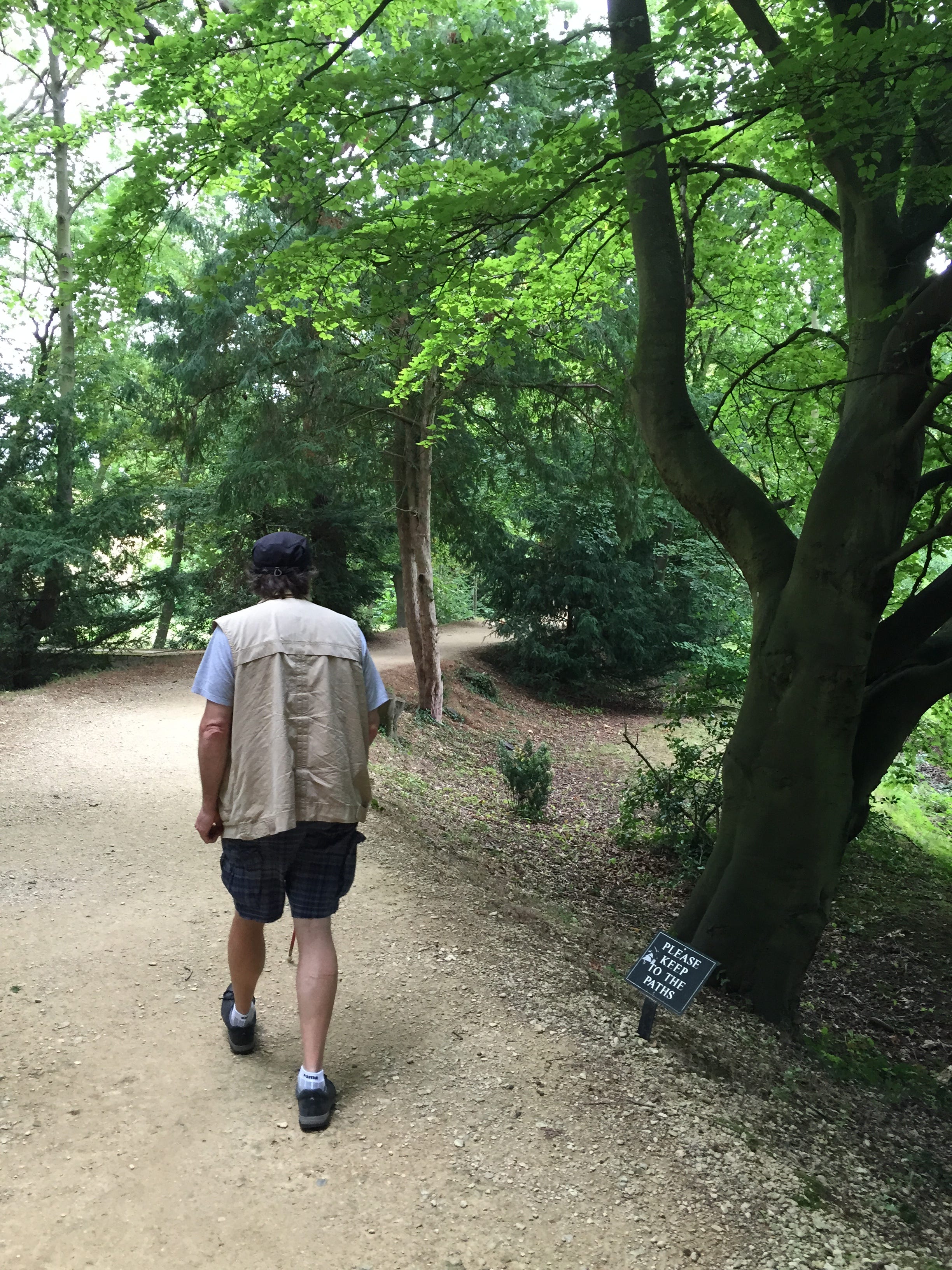
(Addison’s Walk, Magdalen College, Oxford)
Beautiful and insightful, Bill. "that piercing sense of swelling possibility infused with loss." Well said!